A new operator copies a competitor’s terms of service, swaps the site name, and ships it with the rest of the launch. It feels like the responsible move — the competitor has been running for years, so their legal pages must be solid, right? Then a member gets caught running a bot, has their credits forfeited and account closed, and points to a clause in those copied terms that the operator never actually read — a clause that contradicts exactly the enforcement action just taken. Now the operator is arguing their own traffic exchange terms of service against themselves.
A traffic exchange terms of service page is not a formality you clone from the nearest competitor. It’s the document that makes your anti-cheat enforcement legally clean, defines what a credit actually is, and gives your payment gateway something to read when a dispute lands. Get it wrong and the failure doesn’t show up at launch — it shows up the first time you try to enforce a rule, reverse a payout, or defend a chargeback. By then the gap is expensive.
This is the operator-facing guide to the traffic exchange legal pages a self-hosted exchange needs before it goes live — why TE legal pages diverge from generic SaaS templates, the four pages every exchange needs at launch, and the specific clauses that determine whether your enforcement holds up. If you’re still working through everything that has to be in place before you open registration, our traffic exchange launch checklist puts legal pages where they belong: as required items, not optional polish.
Not legal advice: This post explains what TE operators typically need and why — it is not a substitute for qualified legal counsel. Review your legal pages with a local attorney before publishing, especially if you serve EU members or operate under specific regulatory frameworks.
Why a TE Can’t Just Borrow a SaaS Privacy Policy
Generic legal templates assume a generic business: a company sells a subscription, the customer uses software, money moves one direction. A traffic exchange breaks that model in three ways that standard templates never anticipate, and each gap is a place enforcement falls apart later.
First, a TE runs an internal currency. Credits aren’t dollars, they aren’t loyalty points, and they aren’t a refundable balance in the way a SaaS account credit is. Your terms have to define what a credit is, that it carries no cash value, that it’s forfeitable under defined conditions, and that the operator can adjust credit ratios. A generic template has no concept of any of this because the business it was written for doesn’t issue a currency.
Second, a TE makes advertising claims on behalf of its members. Every campaign a member submits is content you’re displaying to other members. That creates an advertising-standards obligation no SaaS template covers — what’s prohibited (illegal offers, malware, deceptive claims), who’s liable, and how you handle takedowns. The FTC’s guidance on deceptive advertising is a practical baseline for scoping your prohibited-content list, even for non-US operators. Without it, you’re displaying whatever members upload with no documented right to remove it.
Third — and this is the one that bites hardest — a TE enforces behaviour. Bot detection, multi-account flags, surf-timing anomalies all lead to account actions: suspension, credit forfeiture, payout reversal. Every one of those actions has to be authorised somewhere in the terms the member agreed to at registration. The anti-cheat engine can flag a cheater perfectly, but if the terms don’t grant you the right to act on the flag, you’re enforcing a rule that doesn’t exist on paper. The technical side of that enforcement is covered in our post on traffic exchange anti-cheat — the legal side is what makes it stick.
The pattern across operators who run into trouble is the same: they treated their traffic exchange legal pages as a compliance checkbox instead of operational infrastructure. The pages aren’t there to satisfy a lawyer. They’re there to back every action the platform takes against a member’s money or account.
The Four Pages Every Exchange Needs Before Launch
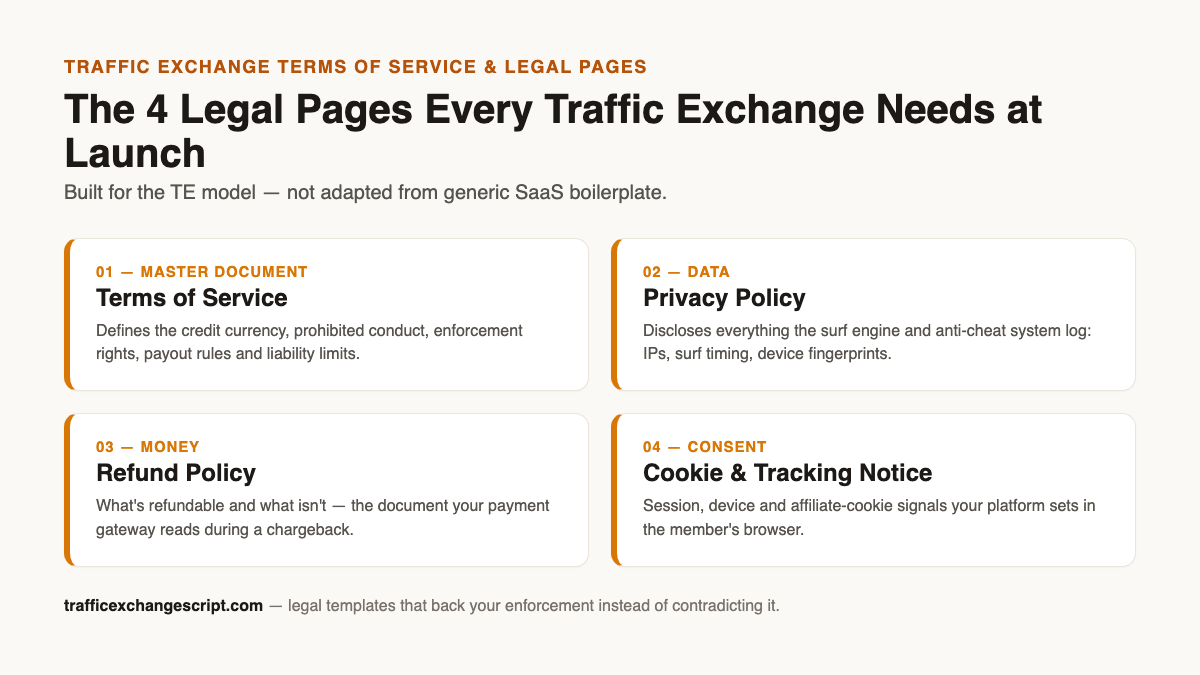
You don’t need a fifty-page legal library to launch. You need four pages, each doing a specific job:
Terms of Service. The master document. It defines the relationship, the credit system, prohibited conduct, enforcement rights, payout rules, and liability limits. Everything else references back to it.
Privacy Policy. What data you collect, why, how long you keep it, and who you share it with. For a TE this is heavier than operators expect — more on that below.
Refund Policy. When upgrades and credit purchases are refundable, when they aren’t, and how disputes are handled. This page does double duty: it manages member expectations and it’s what your payment gateway reads during a chargeback.
Cookie & Tracking Notice. What you track in the browser, including the session and device signals your anti-cheat system relies on, plus any affiliate cookies.
These four cover the launch baseline for most jurisdictions. Operators serving EU members layer GDPR-specific disclosures into the privacy policy; operators taking card payments align the refund policy tightly to their processors. But the four-page structure is the floor, and skipping any one of them leaves a specific operational gap — no defined currency, undisclosed data collection, undefended chargebacks, or untracked consent.
Traffic Exchange Terms of Service: The Clauses That Actually Get Tested
Most of a traffic exchange terms of service page is standard. A handful of clauses are TE-specific, and those are the ones that get tested in practice. After supporting operators through enough enforcement disputes, the same clauses come up every time:
Account termination for cheating. State explicitly that bot use, auto-clickers, multiple accounts, and surf manipulation are grounds for immediate termination. Name the behaviours. Vague “we reserve the right to terminate for any reason” language is weaker than a specific list when a terminated member pushes back, because specificity shows the rule existed before the violation.
Credit forfeiture. Spell out that credits earned or held are forfeit on termination for cause, and that credits carry no cash value. Without this, a terminated cheater can argue you owe them the cash equivalent of a credit balance you just wiped.
Payout reversal. If you run a referral commission or any cash-out feature, reserve the right to reverse payouts traced to fraudulent activity. The reversal right has to predate the fraud — you can’t invent it after you find the bad payout.
Advertising standards. Define prohibited campaign content and reserve the right to reject or remove any campaign without refunding credits spent on disallowed content. This is what lets you pull a malware-laden campaign without owing the member their credits back.
Liability limitation. Standard but essential — cap your liability, disclaim warranties on member-submitted content, and make clear members advertise at their own risk.
The thread connecting all five: each one authorises an action you will actually take. A traffic exchange terms of service page full of clauses you’ll never enforce is noise. The clauses above are the ones that turn an anti-cheat flag, a fraud signal, or a bad campaign into a defensible action instead of an argument.
What Your Privacy Policy Has to Disclose That You Forgot You Collect
Here’s where operators consistently under-disclose. A traffic exchange collects far more data than the registration form suggests, because the anti-cheat and surf-tracking systems are logging constantly in the background. Your privacy policy has to disclose all of it.
The data a TE collects that routinely goes undisclosed:
- IP addresses and logs — captured on every surf session for anti-cheat, not just at login.
- Surf timing data — how long a member views each site, used to detect automation. This is behavioural data and members have a right to know it’s recorded.
- Device fingerprints — browser, OS, and device signals used to catch multi-accounting. This is exactly the kind of tracking GDPR and similar regimes care about.
- Referral relationships — who referred whom, retained for commission tracking.
- Payment metadata — handled by your gateway, but your policy still has to disclose that it’s collected and shared with the processor.
Operators serving EU members need the GDPR layer on top: a lawful basis for each processing purpose, a data-retention period, the right to access and deletion, and a clear contact for data requests. The official GDPR text is the authoritative reference, and the practical takeaway for TEs is that your anti-cheat logging is “processing personal data” whether you framed it that way or not. Disclose it, give it a retention window, and you’re covered. Leave it implicit and you’ve got undisclosed surveillance sitting under a fraud-prevention label.
The fix is straightforward: map every system that writes to your database — registration, surf engine, anti-cheat, referral tracking, payment module — and make sure each data point it captures appears in the privacy policy. If a system logs it, the policy discloses it.
Refund Rules That Hold Up When a Gateway Reads Them
Your refund policy has two audiences. The first is members, who read it to know what they’re entitled to. The second — the one operators forget — is your payment gateway, which reads it during a chargeback to decide whether you handled the dispute fairly.
That second audience is why the refund policy can’t just say “all sales final” and move on. When a member files a chargeback, Stripe or PayPal pulls your stated refund policy and checks whether you offered the remedy you promised. A clear, fair, consistently-applied refund policy is part of the evidence package that wins disputes. A vague or contradictory one undercuts your own defence. The connection between refund language and gateway behaviour is covered in depth in our guide to traffic exchange payment gateways — the short version is that your refund policy is a document your processor uses against you or for you depending on how you wrote it.
Practical structure for a TE refund policy:
- Upgrade plans — define a clear window (e.g. refundable within X days if the upgrade benefits haven’t been substantially used) and state what “used” means in credits or features.
- Credit purchases — typically non-refundable once credits are spent; refundable on unused balances at your discretion. State which.
- Forfeiture on termination — cross-reference your traffic exchange terms of service so the no-refund-for-cause case is explicit.
- Chargeback policy — state that filing a chargeback without first contacting support is grounds for account review, which discourages the dispute-first behaviour that drives up your gateway dispute rate.
The cookie and tracking notice rounds this out — most of it is standard consent language, with one TE-specific wrinkle: affiliate cookies. If you run referral tracking through cookies, disclose it, because an undisclosed affiliate cookie is the kind of thing that turns a routine compliance review into a problem.
How Traffic Exchange Script Handles the Legal Layer
Traffic Exchange Script ships with editable templates for all four pages — Terms of Service, Privacy Policy, Refund Policy, and Cookie & Tracking Notice — written for the traffic exchange model rather than adapted from a generic SaaS boilerplate. The credit-currency definitions, anti-cheat enforcement clauses, advertising-standards language, and the data-collection disclosures that match what the surf engine and anti-cheat system actually log are already in place.
We built the templates this way because of the exact pattern in this post: operators were launching with copied traffic exchange legal pages that contradicted their own enforcement, under-disclosed their data collection, and gave their gateways nothing useful to read during disputes. The templates are starting points, not legal advice — every operator should review them against their own jurisdiction and, where the stakes warrant it, have a local professional check them. But they start from a document built for a traffic exchange instead of one stretched to fit.
The templates live in the admin panel as editable pages. Customise the company details, adjust the refund windows and credit ratios to match your configuration, add any jurisdiction-specific clauses you need, and publish. The structure — the parts that make enforcement clean and disclosures complete — is already there.
Don’t Launch on Borrowed Traffic Exchange Legal Pages
A copied traffic exchange terms of service is a liability wearing the costume of due diligence. It looks like you handled the legal side, right up until the first time you try to enforce a rule and discover the document you’re standing on was written for someone else’s business. The operators who avoid that moment start from traffic exchange legal pages built for the model — currency defined, enforcement authorised, data disclosed, refunds aligned to their gateways.
Traffic Exchange Script ships with all four pages as editable templates written for the TE model, so you launch with legal pages that back your enforcement instead of contradicting it. Pick the license tier that fits your operation, customise the templates to your jurisdiction, and go live on a foundation that holds up the first time you have to use it.